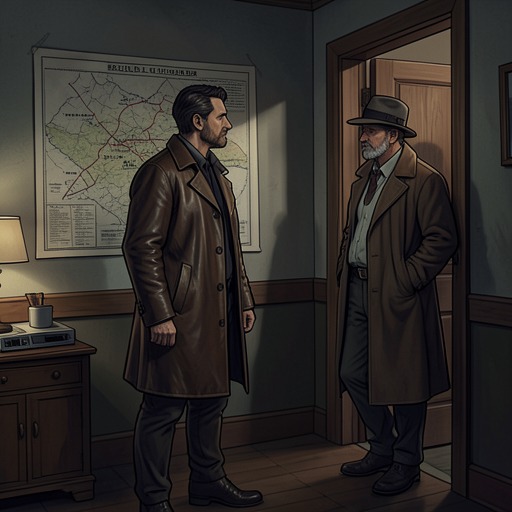
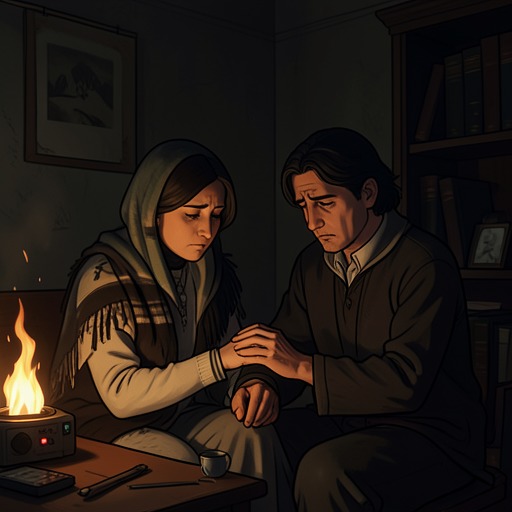
Marriage linking Mollie and Ernest Burkhart
Killers of the Flower MoonMollie Burkhart and Ernest Burkhart’s marriage joined an Osage woman with a white Texas-born man in a relationship shaped by affection, cultural difference, family duty, and the pressures surrounding them. Ernest learned Mollie’s language and cared for her when diabetes made her ill; Mollie, in turn, built a family and household with him. Their marriage, solemnized in 1917, appears in these episodes not as an abstract union but as a daily partnership whose intimacy is tested by sickness, parenting, and bereavement.
Meeting and the making of a partnership
Ernest came to Fairfax in 1912, at nineteen, leaving the poor cotton-farming family in Texas where he had grown up to live with his uncle, William K. Hale. Hale was a domineering cattleman and became a surrogate father to Ernest. Ernest mainly ran errands for him, but also worked as a livery driver; while chauffeuring Mollie around town, he met her. The beginning of their relationship thus lay within the orbit of Hale’s household and influence, even as it developed into a marriage of their own.
Ernest was twenty-eight by the time of the events described in 1921. He drank moonshine and played Indian stud poker with disreputable men, but the account also describes a tenderness beneath his rough manner and a trace of insecurity. Mollie fell in love with him. When he heard that another man was interested in her, he reacted with distress at the possibility of losing her. That response conveys the intensity of his attachment, while the narrative’s attention to his insecurity keeps the courtship from appearing effortless or untroubled.
Affection across language and social boundaries
Mollie was born speaking Osage and learned some English at school. Ernest made the reciprocal effort to study her native language until he could speak with her in it. The detail matters to the relationship: their communication did not depend solely on Mollie adapting to Ernest’s world. His effort to meet her linguistically accompanied more practical care. Mollie had diabetes, and Ernest looked after her when her joints hurt and hunger burned in her stomach.
Their attachment nevertheless met resistance from more than one direction. Ernest’s roughneck friends mocked him for marrying an Osage woman. Mollie, whose three sisters had married white men, still felt responsible for entering an arranged Osage marriage as her parents had. Her family also combined Osage and Catholic beliefs, a religious and cultural inheritance reflected in her struggle to understand why a love that seemed granted by God might be taken away. The account presents this tension without reducing Mollie’s choice to either a simple rejection of tradition or a surrender to it: she felt the weight of family custom and chose Ernest.
In 1917, Mollie and Ernest exchanged rings and promised enduring love. The marriage was therefore both an intimate decision and a crossing of expectations—social, familial, and cultural. Their vows did not erase those pressures; they established a shared life within them.
Children, illness, and family responsibilities
By 1921, Mollie and Ernest had a two-year-old daughter and an eight-month-old son, James, nicknamed Cowboy. The young family lived in Mollie’s large wooden house in Gray Horse, near her family’s older lodge. Mollie’s household included servants, several cars, and the routines required to care for two small children. The marriage had become a domestic partnership with concrete responsibilities, not only a courtship sustained by affection.
Mollie’s care extended beyond her own children. Her mother, Lizzie, had moved into the house after Mollie’s father died. Because of Mollie’s diabetes, Lizzie had once feared that her daughter might die young and had urged her other children to look after Mollie. In practice, Mollie was the one caring for the family. On the day Anna Brown came to help tend to Lizzie, Mollie was preparing to host a small luncheon, feeding the children and organizing the household. When Cowboy had earaches, she blew into his ears until he stopped crying. These ordinary acts make visible the labor surrounding the marriage: Mollie was a wife and mother, but also a daughter managing a household in which care flowed across generations.
Support in bereavement
After Anna’s death, Ernest’s role appears again through his support for Mollie. A lawyer who knew the couple remarked on the unusual and striking quality of his devotion to his wife and children. Ernest comforted Mollie as she organized Anna’s funeral, a task that involved both grief and the practical burden of arranging an expensive burial.
The undertaker charged $1,450 for the casket, $100 to prepare and embalm the body, and $25 to rent a hearse; additional items, including gloves for the grave digger, further increased the bill. The account places these charges within a broader pattern of undertakers exploiting Osage families. Mollie arranged a service reflecting the family’s Osage and Catholic traditions. The marriage is shown here through Ernest’s presence beside her as she undertook that work, not through a speech or gesture that would displace her grief or her responsibility.
Across these episodes, the relationship is defined by a contrast between social strain and private attentiveness. Ernest’s friends derided the marriage, while Ernest learned Mollie’s language and cared for her; Mollie faced expectations about an arranged marriage, then built a home and family with him. The evidence emphasizes their early bond and the support Ernest offered during bereavement, while also showing the demanding network of care in which their marriage was embedded.